
After Greenland
There are several reasons the US covets Greenland but what's more important is the signal of the US's rhetoric. The world's changed, Aotearoa's geopolitical thinking needs to change as well.

Jacob Shapiro provides a great discussion about the potential reasons for the US’s interest in Greenland, including historical precedents.
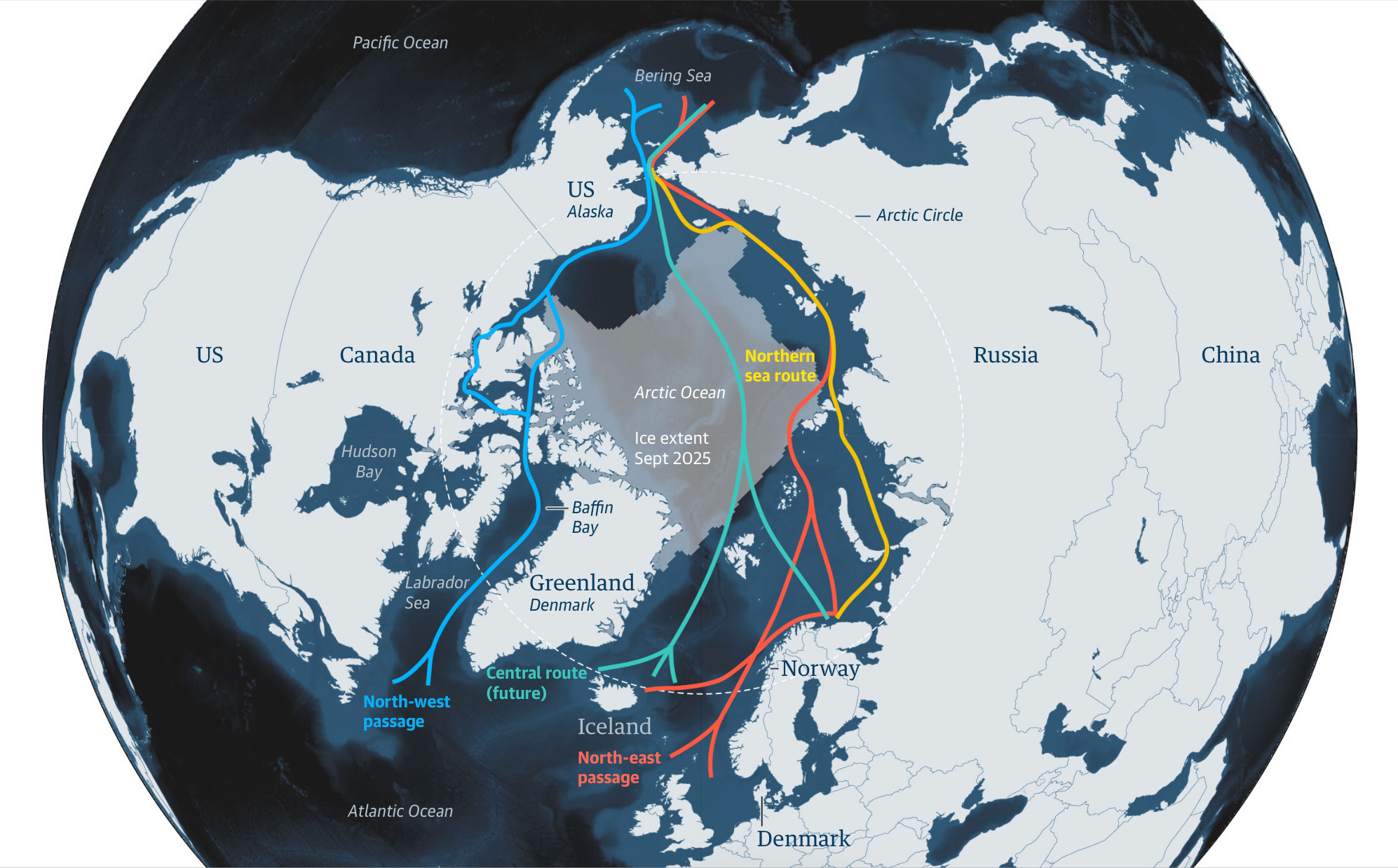
The most important point he makes is that the greatest value of Greenland to the US is not its mineral resources, but its strategic location. It is critical for controlling marine access to, and exit from, the Arctic Circle as part of the “Greenland-Iceland-UK Gap”.
With decreasing sea ice in summer, the Arctic Circle is becoming more navigable, though still a difficult passage. Last year a container ship made the first passage from China to Europe via the Northern sea route, or “Polar Silk Road”, making the trip about seven days shorter than via the Suez canal.
Economic potentials
While several commentators have highlighted the potential mineral (and oil and gas) wealth in and around Greenland as an objective, mining the minerals will be difficult and expensive, Shapiro notes, with existing sources elsewhere more readily accessible to the US. The US also lags China by a considerable margin in the ability to refine and process rare earth metals, though America is already taking steps to reduce that gap.
Others suggest that supporters of the US President may have additional uses for Greenland, such as providing locations for “Freedom cities” – self-governing, regulation-light fiefdoms run by billionaires. Such libertarian dreams have been around for awhile, but not (yet) successfully implemented.
Zanzibar has recently created a special economic zone to establish a “Cyber city” – a “network state” attracting (virtual) technology citizens. In the hope (for Zanzibar) of emulating Singapore’s economic success, and for tech-bros in having unfettered opportunities to establish libertarian rule.
Rationality may not apply
Meanwhile in Greenland. As Shapiro points out, these military and economic objectives can be achieved without invading or seizing the island, and with less geopolitical chaos. But the US President doesn’t seem to make rational strategic decisions, so we shouldn’t assume that his Administration is seeing things the same way as Western allies.
The US may act aggressively not from logic or “grand strategy” but because, as Stephen Miller and his boss assert, they believe that they can do whatever they want.
“Geopolitical analysts often gets things wrong when they assume the actors they are analyzing see the same constraints they do. But if the U.S. decides to hell with constraints and goes after Greenland with Stephen Miller-style force and aggression, the consequences will be more far-reaching and deleterious to U.S. grand strategy than recent events in Venezuela.” Jacob Shapiro
Writing in The Conversation Adriana Marin points out that the takeover of Venezuela was an echo of the US’s invasion of Panama in 1989.
“The language has evolved and the methods have adapted, but the underlying assumption remains stable: that when powerful states deem it necessary, sovereignty can be suspended, legality reinterpreted and intervention justified after the fact.”
Greenland would be a continuation of this theme, with even less justification (no illicit drug cartels, no illegitimate government). If the US does annex Greenland the issue of most relevance for futures is the international response. We’ve already seen very muted condemnation after the US attacks on Venezuela.
“While global opposition may be louder, the enforcement capacity of international law remains limited. As Panama demonstrated, condemnation without consequence does little to deter future interventions.” Adriana Marin
The world’s changed, Aotearoa must too
Interests rather than values have been the priority, both here and elsewhere – don’t unduly antagonise the US. But as many others have pointed out, the US is dismantling seven decades of rule-based global governance. Discarding values in favour of short-term interests benefits only the authoritarians. Where is Aotearoa New Zealand’s place in the world then?
Regardless of what happens in Greenland, we are coming to the end of an era. Climate and other disruptions seem likely to exacerbate the tensions of might over rights.
Meanwhile, China is making its case for a new multipolar world order, with the promise of a “more equitable” multilateral governance system.
And Saudi Arabia is hedging its geopolitical bets by as well as striking deals with the US is buying military jets from China and signing a mutual defence pact with Pakistan.
Do we want a future of geopolitical “day trading”, where what matters is just economic advantages (and the insecurity and destructiveness of might is right)? Or do we want to nurture a return to more rational and effective international institutions, and encourage the emergence of more values-driven political leaders rather than continue with the limited competencies and outlooks of managerial politicians?
We can’t rely on hope that in three years time the US will come back to its senses. We have discarded the notion of a “great white knight/saviour” in other contexts, so what are Aotearoa’s paths forward to help create and better navigate a new world?